Casaubon’s paranoid breakdown
Foucault's PendulumCasaubon’s paranoid breakdown is the crisis in which his fear that the Plan governs the world overtakes his ability to distinguish evidence from interpretation. After leaving the Conservatoire, he sees Paris as territory occupied by hidden initiates, reads the Eiffel Tower as proof that the Plan is real, and seeks Dr. Wagner in the hope of being told that his visions are madness. Wagner’s final judgment confirms that Casaubon is “fou,” but the scene supplies no further explanation; the diagnosis closes the consultation without dispelling the fear.
The City as a Hidden System
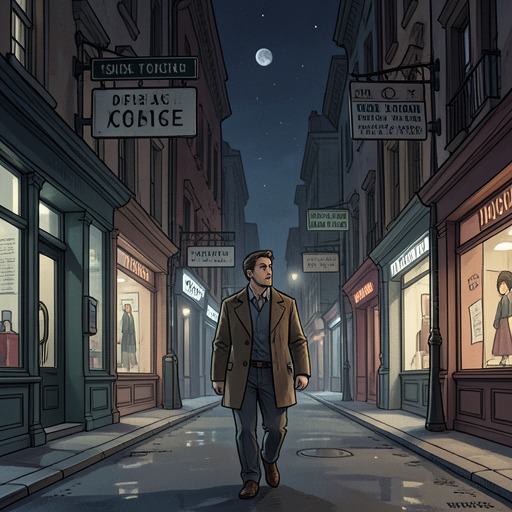
Roaming through Paris at night, Casaubon experiences the city not as an ordinary place but as a landscape whose closed doors, altered buildings, and empty spaces seem to disclose a concealed order. At Place des Vosges, the arcades and shuttered windows become part of a threatening scene. He imagines taxidermists in yellow smocks watching from behind the darkness, though the sight of parked cars, passing shadows, and a lone Belgian shepherd briefly punctures that vision. The alternation between what he sees and what he suspects makes the paranoia visible as a struggle over perception, not merely a settled belief.
The association that draws him onward is Dr. Wagner’s name. Casaubon remembers Avenue Élisée-Reclus from his research for the Plan and identifies Élisée Reclus with writing about the earth and the underground. In his fearful reasoning, such a connection makes Reclus one of Them. The discovery does not reassure him that his route is accidental: it makes every new place feel like another sign that the hidden group surrounds him. He concludes that its members have occupied not only Paris but the rest of the world.
The Eiffel Tower as Proof
At the Eiffel Tower, the interpretive process reaches its most extreme point. Casaubon’s description accumulates grotesque and contradictory images of the structure, turning it into an object that might be a machine, an animal, an altar, or an instrument of cosmic power. He imagines it transmitting the music of the spheres and drawing energy from a hollow planet. The Tower seems capable of swallowing him or transporting him elsewhere; its metal framework becomes both a trap and a mechanism through which the Masters might read their instructions.
The decisive change is that Casaubon ceases to treat these thoughts as possibilities. He takes the Tower’s physical existence as proof that the Plan exists and that Belbo is dead. In this reading, the monument’s reality appears to validate the secret system he has helped imagine, even though the inference itself does not establish the Plan’s truth. The scene binds a concrete landmark to a conclusion produced by fear: because the Tower is real, Casaubon feels certain that the whole conspiracy is real as well.
A taxi interrupts the imagined encounter. Casaubon waves down the driver and nearly gets run over; the driver says that the Tower frightens him too when he passes beneath it at night. That ordinary agreement gives Casaubon’s fear a momentary echo in another person’s reaction, but it does not confirm his supernatural explanation. The episode preserves the gap between a shared response to an imposing structure and Casaubon’s conviction that it is an instrument of the Plan.
Flight and the Need to Be Corrected
Casaubon’s movement through the city is repeatedly flight: away from the Conservatoire, toward Wagner, and then from the places that seem to confirm the conspiracy. He recognizes that he is fleeing, and considers that he needs a strait-jacket or sleep rather than an analyst. He also longs for Lia’s comfort, imagining her holding his head and soothing him. The wish for physical reassurance stands in sharp contrast to the abstract system that has taken over his thoughts: he wants a person who can help him feel grounded, not another secret explanation.
Even so, he insists that he must speak with Wagner. He regards conversation as a remedy, and the prospect of being told that he is raving offers relief. At a restaurant near the Forum des Halles, however, fish in an aquarium prompt further associative visions: religious figures, a homunculus, a Templar, and possible signatures crowd into his interpretation of the scene. Casaubon tries to counter this compulsion by telling himself that the nighttime flight and the Tower vision are normal after what he saw—or believes he saw—at the Conservatoire. The qualification matters: even in the attempt to calm himself, he cannot establish what actually happened there.
His night remains uncertain in its details. He recalls going to a cinema showing Orson Welles’ The Lady from Shanghai, then leaving when the mirror scene became unbearable, but immediately questions whether the visit happened at all or whether he imagined it. The mirrors sharpen the episode’s central problem: Casaubon cannot rely on memory to separate the experienced world from the images and patterns that overwhelm it. The narrative offers his self-doubt as part of the breakdown rather than an external correction that resolves it.
Wagner’s Diagnosis and the Unresolved Ending
The next morning, Casaubon calls Wagner and uses the name Garamond to get past the secretary. Wagner agrees to see him before his regular appointments. In the modest office overlooking the Seine, with the Tower’s shadow visible to the left, the former publisher becomes the patient. Wagner turns his chair away and invites Casaubon to speak. Casaubon then pours out his account, including his earlier thinking, what he believes Belbo and Diotallevi thought, and above all what happened on Saint John’s Eve.
Wagner listens without interrupting, nodding, or visibly disapproving. After Casaubon finishes, he stands and spends ten or fifteen minutes looking out of the window with his back turned. The silence leaves Casaubon waiting for an interpretation, but Wagner offers only a calm, colorless judgment: “Monsieur, vous etes fou.” He does not explain the diagnosis or engage with the Plan point by point. After another five minutes, Casaubon understands that the session is over; he leaves without saying goodbye and finds himself once more on Avenue Élisée-Reclus.
The consultation offers a name for Casaubon’s state but no demonstrated way out of it. Wagner’s authority matters because Casaubon came hoping to have his suspicions disproved, yet the blunt verdict does not undo the meanings he has attached to the Tower, the city, or the events at the Conservatoire. The episode therefore ends on an unresolved boundary: Casaubon has been told he is mad, but the narrative does not turn that statement into an independent verification of every fear he has described.
Narrative Function
The breakdown is presented through Casaubon’s own perceptions and doubts. Its movement from dark streets, through the Tower, to Wagner’s office follows his effort to convert terror into a coherent account and then to submit that account to another person. The city’s ordinary details—doors, cars, an animal, a taxi, an aquarium, a medical appointment—remain present, but each can be pulled into a network of significance. That formal tension lets the reader experience how the Plan’s logic operates without requiring the narrative to certify it.
Casaubon’s repeated need for Wagner to say that he is ill is as important as his conviction that the Plan is real. He seeks a judgment that would release him from the burden of interpretation, while simultaneously returning to signs that seem to strengthen his belief. The final diagnosis gives him the word he had hoped to hear, but not the reassurance or explanation he wanted. His breakdown thus exposes the danger of a system in which every apparent confirmation can be absorbed as another sign—and even the attempt to dismiss the system cannot settle what happened.